
midjourney tutorial
Say Goodbye to Posed Shots: Recreate Japanese Movie Atmosphere with Midjourney
Midjourney AI Team · July 23, 2026 · 7 min read
Keywords: midjourney japanese style, cinematic portrait prompts, midassai studio
Published: July 23, 2026 Author: Midjourney AI Team
Who This Guide Is For
This tutorial is designed for creators who are tired of the sterile, plastic look that often plagues AI-generated portraits. If you are trying to capture a specific mood—nostalgia, longing, or candid motion—rather than just a pretty face, this workflow is for you. We are moving away from standard beauty shots and into the realm of visual storytelling. You do not need to be a professional photographer to understand composition, but you do need to understand how to translate cinematic language into Midjourney parameters. By the end of this guide, you will be able to generate images that feel like stills from a 1990s Japanese film rather than a digital rendering.
The Problem with Standard AI Portraits
Most default Midjourney prompts result in images that feel overly polished. The lighting is too perfect, the skin is too smooth, and the subject is always looking directly at the camera with a symmetric smile. This is what we call the "posed feeling." It breaks immersion because real life is rarely symmetric. Real life involves wind, awkward angles, and distractions in the background.
When you generate a standard portrait, the AI defaults to a high-key lighting setup with a blurred background that screams "stock photo." To fix this, we need to introduce imperfection. We need to tell the AI to look up, not straight on. We need to add environmental elements that suggest a specific place and time. The goal is to create a narrative gap where the viewer wonders what happened just before the shutter clicked.
Deconstructing the Japanese Movie Aesthetic
To replicate this specific vibe, we rely on three core visual pillars. These are not just decorative; they are structural elements that force the AI out of its default beauty mode.
1. The Low Angle Perspective
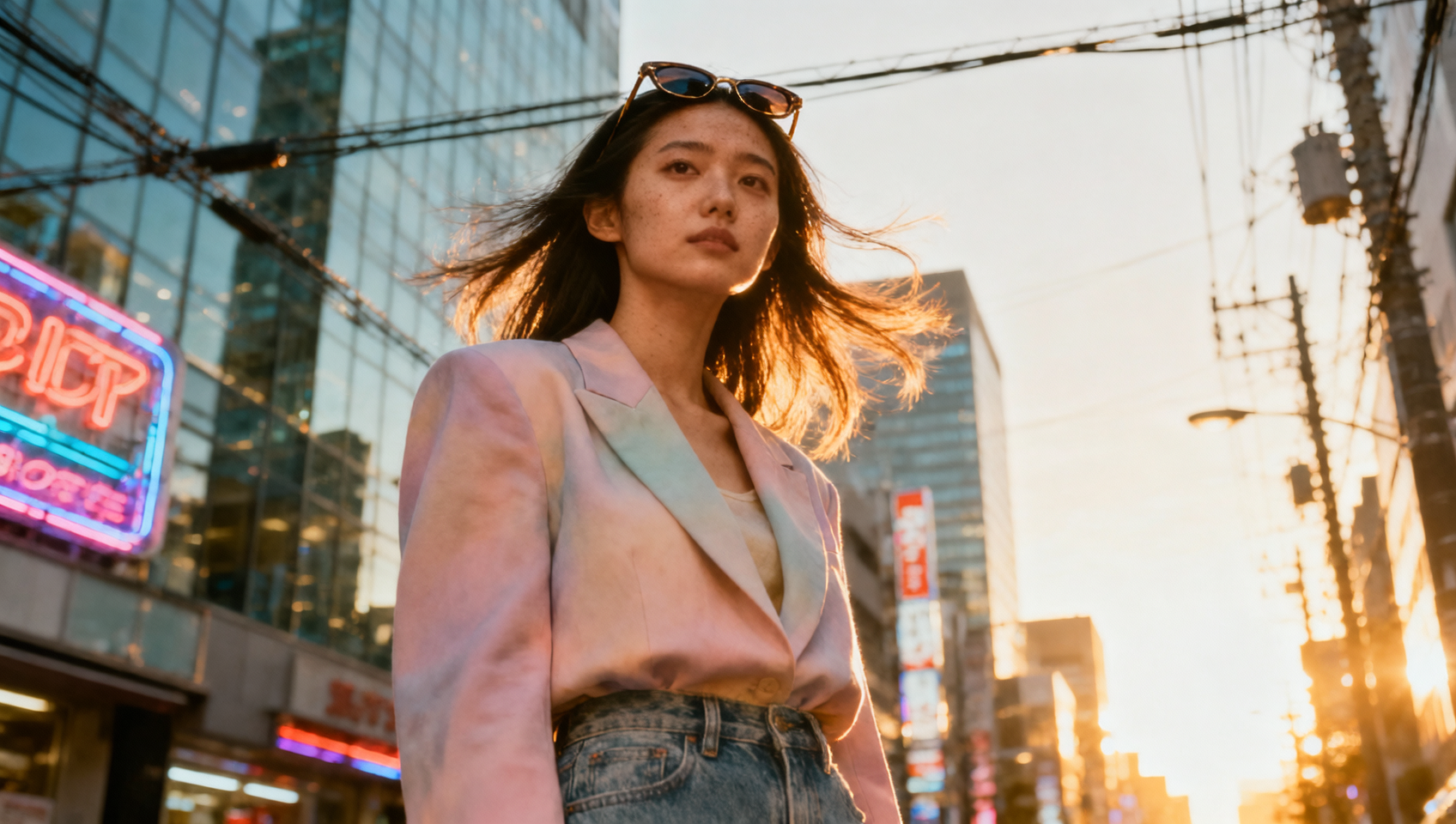
Shooting from below changes the power dynamic of the image. It makes the subject look larger than life while exposing the sky or urban infrastructure above them. In Midjourney, you cannot physically move a camera, so you must describe the angle. Use terms like low angle shot, worm's eye view, or looking up at subject. This immediately removes the standard eye-level portrait composition.
2. The Urban Background (Power Lines)
Nothing says "Japanese city pop" quite like tangled power lines against a twilight sky. This adds texture and depth to the negative space. It grounds the image in a specific reality. Without these details, the background remains a generic blur. Explicitly prompting for overhead power lines, telephone poles, or urban infrastructure gives the AI concrete geometry to render behind the subject.
3. Motion and Wind
Static hair looks fake. Windblown hair suggests movement and time. We want the hair to obscure part of the face occasionally. This imperfection adds humanity. Prompt for windblown hair, hair covering eyes, or dynamic motion. This tells the rendering engine to prioritize motion blur over sharpness in specific areas.
Quick Takeaways
Prompt Engineering and Parameters
Writing the prompt is only half the battle. The parameters you append determine how strictly Midjourney adheres to your artistic intent. For this aesthetic, we recommend using Midjourney Version 7 or higher to leverage improved lighting models.
Here is a base structure you can adapt. Notice how we prioritize the camera angle before the subject description.
/imagine prompt: low angle shot of a japanese girl looking up at the sky, windblown hair covering eyes, overhead power lines, twilight city background, cinematic lighting, film grain, nostalgic mood --style raw --ar 16:9 --v 7
Why Use --style raw
The --style raw parameter is critical here. By default, Midjourney tries to make images beautiful according to its own training data. --style raw reduces this beautification bias. It allows for harsher lighting, more realistic skin texture, and compositions that might otherwise be rejected as "ugly" by the default model. For a movie still look, you want realism over prettiness.
Aspect Ratio and Lighting
We use --ar 16:9 to mimic widescreen cinema. A square or portrait crop feels like social media; a wide crop feels like a film. If you want a more vintage feel, try --ar 4:3. For lighting, avoid terms like "studio lighting." Instead, use natural light, street lamp glow, or golden hour to keep it grounded in the environment.
Exclusive Tips for MidassAI Studio Users
When working within MidassAI Studio Midjourney, you have the advantage of a streamlined interface that manages these parameters for you. However, understanding the underlying logic helps you tweak results when the first generation isn't quite right.
- Iterate on the Gaze: If the subject looks too happy, add
longing gazeormelancholic expression. The emotion drives the lighting. - Control the Wind: If the hair is too messy, add
slight breezeinstead ofstrong wind. - Color Grading: Add
color gradedorfujifilm simulationto the prompt to push the color palette toward that specific nostalgic teal and orange look common in City Pop visuals.
If you find yourself constantly adjusting these settings, consider saving your preferred parameter sets in your workspace. You can access the full power of these tools directly by trying workflows in MidassAI Studio Midjourney.
Beyond Static Images: The Multimodal Future
While this guide focuses on static imagery, the principles of composition remain the same for video and audio generation. The "posed feeling" is equally detrimental in AI video. When you move to generating video clips based on these images, maintain the low angle and environmental noise.
The next step in your workflow might involve animating these stills. Tools that convert images to video rely on the depth cues you established in the prompt. If you have power lines in the background, the parallax effect during motion will be much more convincing. Similarly, AI music generators can pick up on the "nostalgic" and "city pop" tags in your prompt metadata to generate matching soundscapes. Treating your image generation as part of a larger media pipeline ensures consistency across all assets.
Why the Posed Feel Breaks Immersion
Ultimately, the reason we avoid the posed look is psychological. Viewers subconsciously recognize when an image is staged. A subject looking directly at the lens demands attention from the viewer. A subject looking away, obscured by hair, or framed by ugly power lines invites the viewer to observe a moment they weren't part of. This is the difference between a portrait and a story.
Midjourney is capable of both, but it defaults to the portrait. It is your job as the prompt engineer to push it toward the story. By manipulating angle, environment, and motion, you reclaim the narrative. Do not settle for the first grid. Use the variation tools to refine the wind direction or the density of the background wires.
Final Thoughts
Creating authentic atmospheric images requires a shift in how you describe scenes. Stop describing the person and start describing the moment. The low angle, the wires, and the wind are not just details; they are the context that makes the image believable. Experiment with these parameters in your next session. For a more integrated experience where you can manage these generations alongside your other AI tools, head over to MidassAI Studio.
Ready to stop generating stock photos and start making art? Try Midjourney in MidassAI Studio to access these advanced workflows today.