
midjourney
Midjourney V8 Launches: 5x Faster Generation and V7 Personalization
Midjourney AI Team · July 23, 2026 · 6 min read
Keywords: midjourney v8, midjourney prompts, ai image generation
Published: July 23, 2026 Author: Midjourney AI Team
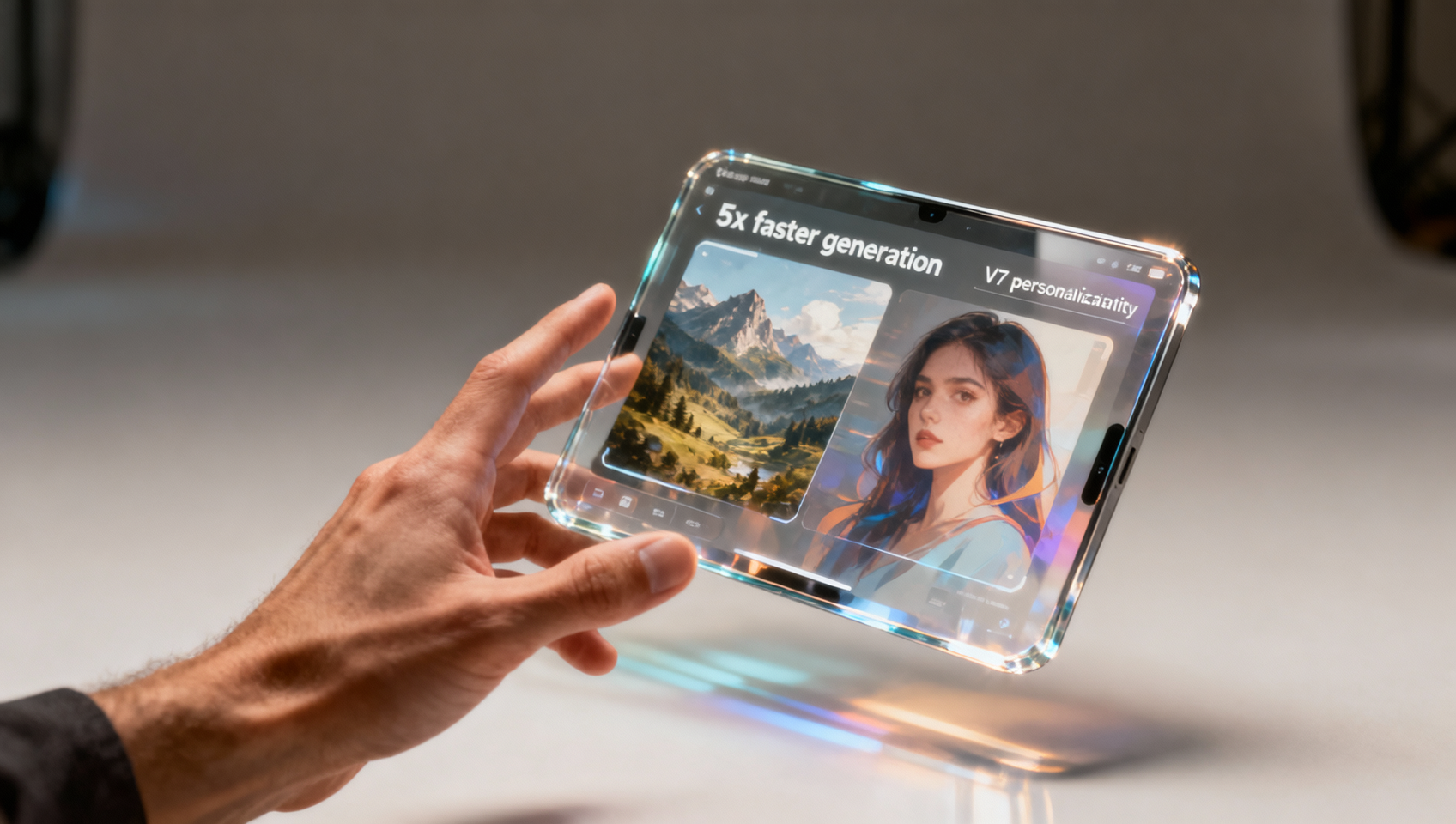
Midjourney V8 Overview: Speed and Continuity
The release of Midjourney V8 marks a significant shift in how professionals approach generative AI workflows. While previous updates focused heavily on aesthetic improvements, V8 prioritizes velocity without sacrificing the fidelity established in version 7. For agencies, concept artists, and content creators, the reduction in generation time is not just a convenience; it is a fundamental change in production capacity. This overview details the technical highlights of V8, explains why generation speed impacts prompt engineering, and outlines the migration path from V7 to V8 within the MidassAI Studio environment.
Key V8 Highlights and Technical Improvements
The headline feature of Midjourney V8 is the generation speed. Benchmarks indicate an approximate 5× improvement in processing time compared to V7. In practical terms, a grid of four variations that previously took 60 seconds now renders in roughly 12 seconds. This reduction allows for rapid iteration cycles that were previously cost-prohibitive in terms of time.
Beyond speed, V8 maintains full compatibility with V7 personalization features. This is critical for users who have invested time in tuning style references (--sref) and character references (--cref). You do not need to rebuild your library of style codes. A style reference generated in V7 works identically in V8, ensuring brand consistency remains intact during the transition. The model also shows improved adherence to complex prompt structures, reducing the need for excessive negative prompting or parameter tweaking to achieve basic composition goals.
Quick Takeaways
Why Speed Matters for Prompt Workflows
In professional environments, latency is the enemy of creativity. When using earlier versions, the wait time between idea and visualization often disrupted the flow state. Artists would formulate a prompt, submit it, and then context-switch to another task while waiting. This fragmentation reduces the total number of iterations possible within a billing cycle or workday.
With V8, the feedback loop tightens significantly. You can test variations of lighting, camera angles, or texture descriptors in real-time. For example, if you are designing a product concept, you can run a batch of tests using --ar 16:9 for wide shots and --ar 4:5 for social media crops within minutes. This speed enables a "prompt chaining" workflow where the output of one generation immediately informs the next prompt refinement.
Furthermore, faster generation reduces the computational load on your mental resources. You spend less time managing queue times and more time refining the artistic direction. For teams using MidassAI Studio, this means higher throughput on client projects. You can present multiple distinct directions to a stakeholder in the time it previously took to generate a single option. This capability changes the economics of AI-assisted design, making it viable for tighter deadlines where previous versions were too slow to be practical.
Moving from V7 to V8: Migration and Parameters
Migrating to V8 requires minimal adjustment to existing workflows, but there are best practices to ensure you leverage the new model's capabilities. The primary method to access the new version is by adding the --v 8 parameter to your /imagine commands. If you omit this, the system may default to the previous stable version depending on your account settings.
Parameter Compatibility
Most parameters remain consistent between versions. However, V8 responds differently to weightings.
- Style Raw: The
--style rawparameter continues to function as a way to reduce the model's default aesthetic bias. In V8, this parameter is even more effective at adhering strictly to the literal prompt without adding artistic flourish unless requested. - Aspect Ratios: Standard aspect ratios like
--ar 16:9,--ar 3:2, and--ar 1:1perform with higher consistency in V8. Cropping artifacts are reduced, making outpainting workflows more reliable. - Chaos and Stylize: The
--chaosand--s(stylize) parameters retain their logic. However, because V8 is more prompt-adherent, you may find you need lower--svalues to achieve the same level of artistic interpretation that required higher values in V7.
Workflow Adjustments
When transitioning, audit your existing prompt library. Prompts that relied on verbose descriptions to force composition in V7 may need simplification in V8. The new model understands spatial relationships better. A prompt like "a cat sitting on a mat, the cat is on the left, the mat is on the right" may yield better results in V8 without needing complex weighting syntax like (cat:1.5).
It is recommended to run parallel tests. Generate a key asset in V7 and then in V8 using the same seed and prompt. Compare the results to understand the nuanced shifts in texture and lighting. This comparison helps you calibrate your expectations and adjust your prompt vocabulary accordingly.
Optimizing for MidassAI Studio Midjourney
Using Midjourney within MidassAI Studio provides a structured interface for managing these versions. The studio environment allows you to save prompt presets that include version parameters. This ensures that team members do not accidentally revert to V7 when V8 is required for a specific project phase.
The studio also facilitates the organization of style references. Since V8 maintains compatibility with V7 personalization, you can upload your existing --sref URLs directly into the studio's asset library. This centralizes your brand's visual language, making it accessible for all team members to apply to new generations instantly.
For video and music workflows, the speed improvements in image generation indirectly benefit downstream processes. Faster concept art means faster storyboarding, which accelerates the pre-production phase for AI video projects. While Midjourney primarily focuses on static imagery, the assets created here often serve as inputs for video generation tools. Having high-fidelity, quickly generated base images streamlines the entire multimedia pipeline.
Final Thoughts on the V8 Rollout
The transition to Midjourney V8 is less about learning a new tool and more about unlocking the potential of the tool you already use. The continuity with V7 personalization ensures that your historical work remains relevant, while the speed improvements open new possibilities for volume and iteration.
For professionals, the ability to generate studio-grade output at 5× the speed changes the viability of AI in production pipelines. It moves generative AI from a novelty exploration tool to a core component of the design process. To experience these improvements directly and manage your versioning effectively, you should integrate these workflows into a dedicated environment.
Ready to accelerate your creative process? Try Midjourney in MidassAI Studio to access the latest V8 features and manage your generation workflows efficiently.