
midjourney
Midjourney Prompt Basics and Parameters: Turn Words Into Images
Midjourney AI Team · July 23, 2026 · 7 min read
Keywords: midjourney prompts, ai image generation, midjourney parameters
Published: July 23, 2026 Author: Midjourney AI Team
Understanding the Engine Behind Generative Art
Generating compelling imagery with AI is less about magic and more about communication. When you interact with Midjourney on MidassAI Studio, you are directing a latent space model to navigate towards a specific visual outcome. The prompt is your navigation system. Without a clear understanding of how the model interprets text, you are essentially guessing. This guide breaks down the mechanics of prompt construction, moving beyond simple descriptions into structured commands that yield consistent, high-fidelity results.
Many users stop at the subject matter, typing "a cat" and expecting a portfolio-ready image. The model will provide a cat, but it will be average. To achieve professional output, you must layer context, style, and technical parameters. We will focus on the current stable version, utilizing /imagine syntax compatible with version 7 (--v 7), ensuring your workflows remain relevant as the technology evolves.
Who This Guide Is For
This overview is designed for designers, marketers, and content creators who need reliability from their AI tools. If you are tired of rolling the dice on generations and want to understand why an image failed or how to replicate a success, this is for you. It is also suitable for traditional artists looking to integrate AI into their concepting phase without losing creative control. You do not need coding knowledge, but you do need a willingness to iterate.
The Anatomy of an Effective Prompt
A robust prompt follows a logical hierarchy. Think of it as a briefing document for a human photographer or illustrator. The structure generally flows from subject to medium, then to lighting and composition, and finally to technical parameters.
Start with the Subject. Be specific. Instead of "warrior," try "cybernetic samurai wearing worn leather armor." Next, define the Medium. Are you looking for a photograph, an oil painting, or a 3D render? Terms like "macro photography," "cinematic still," or "vector illustration" set the texture expectation.
The Context fills the environment. Where is the subject? What is the time of day? Finally, add Style Modifiers. This is where you inject mood. Words like "moody," "neon-noir," or "minimalist" guide the color palette and atmosphere.
A common pitfall is keyword stuffing. Adding fifty adjectives confuses the attention mechanism of the model. It dilutes the focus. Stick to the most impactful descriptors. If you want a red car, do not also say "crimson vehicle" and "scarlet automobile." Pick one clear term.
Essential Parameters for Control
Parameters are commands appended to the end of your prompt that alter how the model processes the request. They are prefixed with double dashes. Understanding these is the difference between a generic output and a tailored asset.
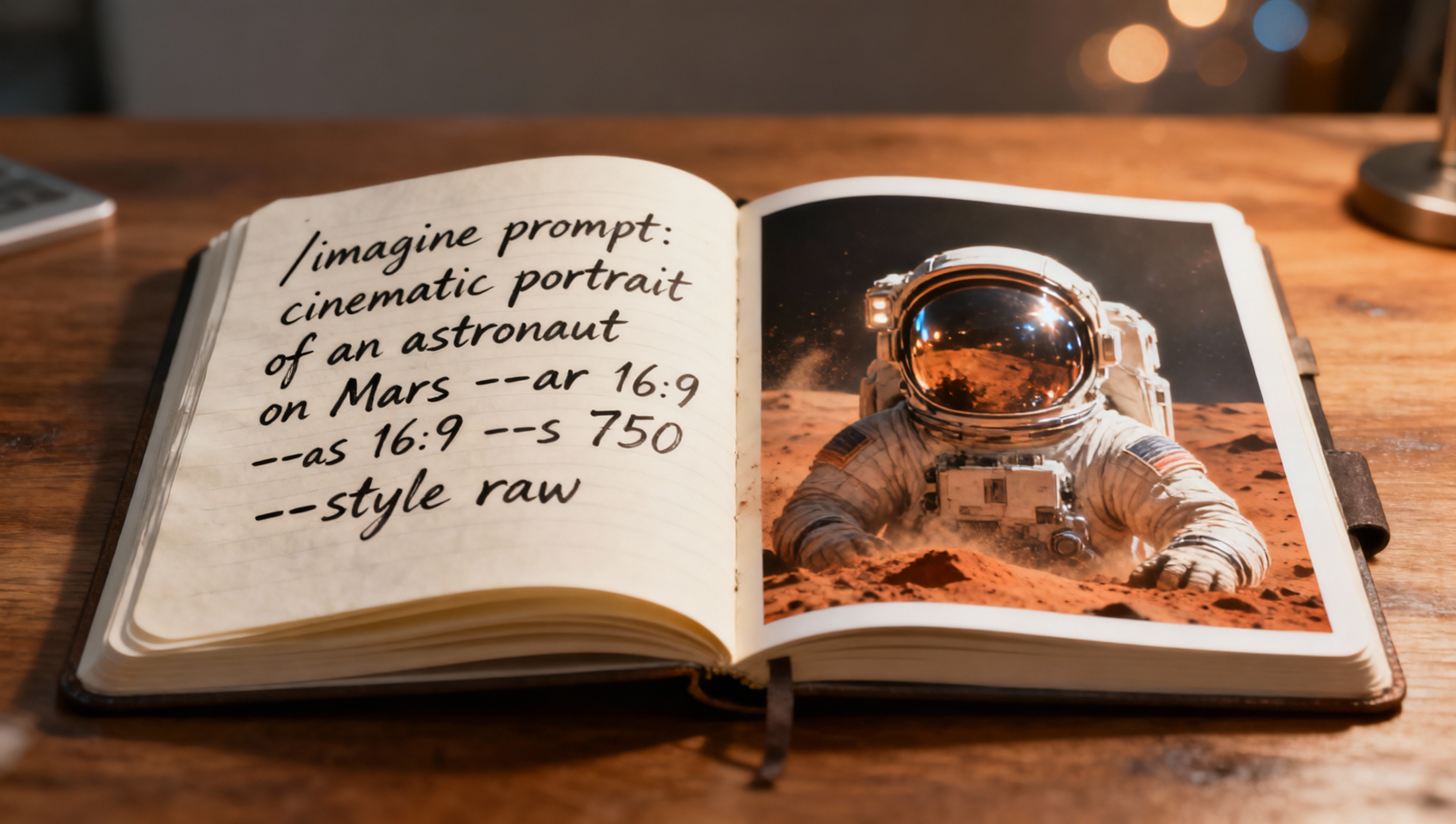
The Aspect Ratio parameter (--ar) is critical for composition. Default squares often crop subjects awkwardly. For social media stories, use --ar 9:16. For cinematic banners, --ar 16:9. In MidassAI Studio, you can adjust this visually, but knowing the syntax allows for precise batch operations.
Stylization (--s) controls how strongly the model applies its own aesthetic bias. A low value (e.g., --s 50) sticks closer to your literal prompt. A high value (e.g., --s 750) allows the model more artistic freedom, often resulting in more beautiful but less accurate images. For product photography, keep stylization low to maintain fidelity. For concept art, higher values inspire creativity.
Versioning (--v 7) ensures you are using the latest model capabilities. Newer versions understand natural language better and handle complex lighting more realistically. Always specify the version in your workflows to prevent drift when the platform updates.
Style Raw (--style raw) is another powerful toggle. It reduces the model's default beautification filters. If you need gritty realism or specific lighting conditions that the model usually "fixes" to look too polished, this parameter is essential.
Quick Takeaways
Controlling Image Size and Resolution
Resolution in generative AI is a two-step process. The initial generation creates a base grid, typically at a lower resolution to save computation time. The true quality comes from the upscaling phase. In Midjourney, you select a variant from the initial grid and choose an upscale option.
When working in MidassAI Studio, you have access to enhanced upscalers that add detail rather than just stretching pixels. However, your initial aspect ratio dictates the maximum usable resolution. If you generate a square image but need a wide banner, upscaling will not fix the composition. You must set the --ar parameter before generation.
Be wary of extreme aspect ratios. While --ar 21:9 is possible, pushing beyond standard cinematic ratios can sometimes result in distorted subjects or duplicated elements as the model struggles to fill the space. Test intermediate ratios like --ar 3:2 for photography standards before committing to ultra-wide formats.
Modifying Your Creations
Once you have a base image you like, the work shifts to refinement. You rarely get the perfect image on the first try. This is where Character Reference (--cref) and Style Reference (--sref) become invaluable.
If you have a character design that needs to appear in multiple scenes, generate the character first. Copy the image URL and append --cref [URL] to your new prompts. This tells the model to maintain facial features and clothing consistency. Similarly, --sref locks in the color palette and artistic style of a reference image.
This workflow is crucial for branding. You can establish a visual identity with one master image and propagate that style across hundreds of assets without rewriting complex style descriptors every time. In MidassAI Studio, managing these references is streamlined, allowing you to save preferred styles for future projects.
Multi-Prompts and Weights
Sometimes you need to balance conflicting concepts. Multi-prompts allow you to separate ideas using double colons ::. This tells the model to treat the text segments as distinct entities rather than a blended sentence.
For example, fire::ice generates an image where fire and ice are separate elements. fire:ice might blend them into a steamy mess. You can also assign weights to prioritize elements. portrait::2 lighting::1 tells the model that the subject's face is twice as important as the lighting setup.
Use weights when the model ignores key components of your prompt. If you ask for a "red car in a blue forest" and the car keeps turning blue, increase the weight on "red car." However, use this sparingly. Over-weighting can lead to disjointed images where elements do not interact naturally.
| Feature | Benefit |
|---|---|
| Speed | Faster creation |
| Quality | Studio-grade output |
Integrating Workflows in MidassAI
Mastering the syntax is only half the battle. The other half is managing the workflow. Generating images is fast; organizing, selecting, and publishing them is where time is spent. MidassAI Studio provides the environment to handle this scale.
You can test different parameter combinations rapidly without leaving the interface. Instead of managing discord bots or command lines, you have a visual dashboard. This allows you to focus on the creative direction rather than the technical overhead. When you are ready to move from experimentation to production, the studio supports higher priority processing and batch generation.
To truly master these tools, you must practice. Take a simple concept and run it through five different parameter sets. Change the aspect ratio. Toggle style raw. Adjust the weights. Observe how each change alters the output. This empirical approach builds the intuition needed to prompt effectively under pressure.
Ready to streamline your generation pipeline? Access the full suite of tools and start creating with precision.