
Psychedelic Forest Midjourney Prompts: Neon Mushrooms & Glowing Trees Guide
Midjourney AI Team · July 23, 2026 · 6 min read
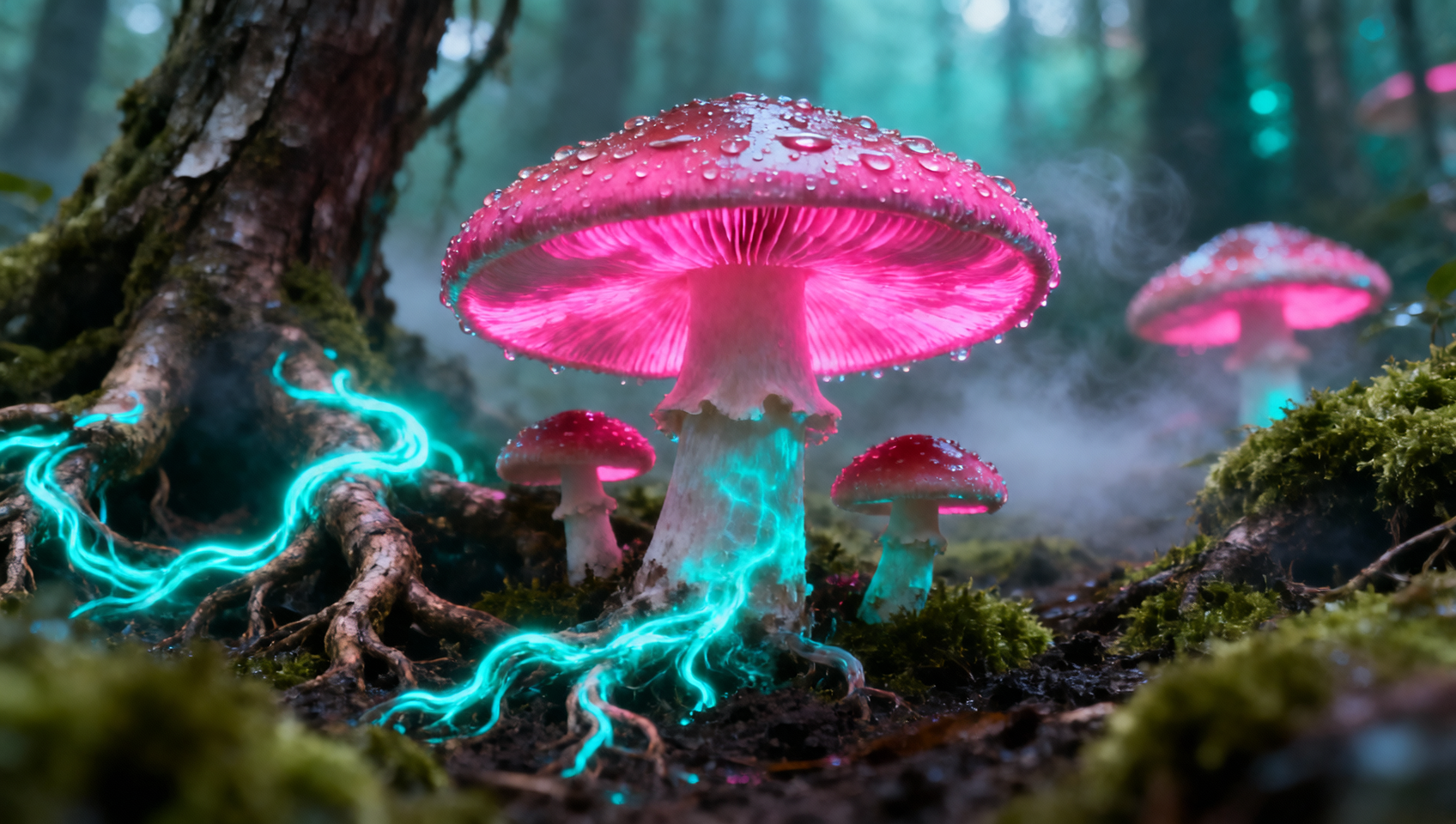
Who This Guide Is For
This guide targets digital artists, concept designers, and hobbyists looking to generate surreal, high-fidelity forest environments using Midjourney. If you are struggling to achieve consistent bioluminescent lighting or find your organic shapes look too generic, this breakdown addresses the specific lexical and parameter adjustments needed for the psychedelic aesthetic. We focus on practical application within the MidassAI Studio environment, ensuring you can move from idea to asset efficiently.
Deconstructing the Psychedelic Aesthetic
Creating a convincing psychedelic forest requires more than just adding the word "trippy" to your prompt. The aesthetic relies on specific biological distortions, unnatural color palettes, and atmospheric density. When working with Midjourney v7, the model understands texture and light interaction significantly better than previous iterations, but it still needs precise direction to avoid slipping into cartoonish territory.
The core elements of this style revolve around three pillars: flora distortion, light emission, and atmospheric depth.
1. Flora Distortion Standard trees and mushrooms will not suffice. You need to specify structural anomalies. Instead of "mushrooms," use terms like "giant amanita muscaria with translucent caps" or "spiraling fungal towers." For vegetation, request "fractal ferns" or "weeping willow branches made of fiber optics." This tells the model to alter the geometry, not just the color.
2. Light Emission Psychedelic environments are defined by self-illumination. Avoid generic "lighting" tags. Specify the source and quality. Use "bioluminescent sap," "neon spores drifting in air," or "phosphorescent moss grounding the roots." The goal is to make the environment feel alive and radioactive without being overly harsh.
3. Atmospheric Depth A flat image kills the dreamlike quality. You need volume. Keywords like "volumetric fog," "dream haze," and "chromatic aberration" add layers between the camera and the subject. This creates the sensation of walking through a dense, unknown ecosystem.
Here is a baseline prompt structure to test in your workspace:
/imagine prompt: dense psychedelic forest, giant neon mushrooms with translucent caps, bioluminescent moss on twisted roots, volumetric purple fog, fiber optic vegetation, surreal color palette, cinematic lighting --ar 16:9 --stylize 250 --v 7
The Keyword Framework for Consistency
Randomly stacking adjectives often leads to chaotic results where the model ignores half your instructions. A structured framework ensures every component of the image receives attention. We recommend a four-part hierarchy: Subject, Style, Light, and Camera.
Subject Definition Be anatomical even when describing fantasy objects. If you want glowing trees, describe the bark texture. "Cracked obsidian bark leaking blue sap" gives the AI a physical surface to render light upon. Vague subjects result in vague textures.
Style Modifiers
This is where you control the artistic rendering. For a photorealistic psychedelic look, use "macro photography" or "octane render." For a painted look, try "oil impasto" or "digital surrealism." Be careful with --style raw. In v7, using --style raw reduces the model's internal aesthetic bias, allowing your prompt keywords to drive the look more directly. This is crucial for niche styles like psychedelic forests where default beautification might sanitize the weirdness you want.
Lighting and Color Separate your lighting from your color palette. Instead of "purple light," try "rim lighting with magenta gels." Define the color grade separately using terms like "teal and orange contrast" or "vaporwave palette." This prevents the lighting from washing out the subject.
Camera and Parameters
Always define the aspect ratio (--ar) early. Wide shots (--ar 16:9 or --ar 3:2) work best for environments to show scale. Close-ups (--ar 4:5) focus on texture. Use --weird sparingly; a value of --weird 500 can introduce the necessary structural anomalies for psychedelic art without breaking the image coherence.
Technical Execution and Workflow Optimization
Generating the image is only the first step. Integrating these assets into a broader production workflow requires attention to parameters and platform capabilities. When you are ready to move beyond static images, consider how these assets feed into AI video or music projects.
Parameter Tuning for v7
Midjourney version 7 handles complex lighting scenarios with greater stability. However, high stylization values can sometimes ignore prompt details. If your neon mushrooms are turning into generic blobs, lower your --stylize value to 100 or 150. If the composition is too rigid, increase --chaos to 10 or 20 to vary the initial grids.
Common Pitfalls
- Over-saturation: Asking for "neon" often results in clipped highlights. Counteract this by adding "moody lighting" or "shadow details" to preserve depth.
- Repetition: AI tends to tile patterns. If your forest looks repetitive, add "organic asymmetry" or "randomized growth patterns" to the prompt.
- Ignoring Negative Space: A cluttered forest feels oppressive. Ensure you prompt for "clearing" or "pathway" to give the eye a place to rest.
Integrating with MidassAI Studio While Midjourney handles the visual generation, a complete creative project often involves motion and sound. You can take your generated forest backgrounds and animate them using AI video tools, or generate ambient soundscapes to match the visual mood. MidassAI Studio provides a unified environment to manage these assets. Instead of juggling multiple logins, you can iterate on your Midjourney prompts and immediately organize the outputs for further processing.
For example, generate a seamless tileable texture of psychedelic moss in Midjourney, then use that texture in a 3D environment or video project. The workflow efficiency gained by keeping your generation and management tools connected cannot be overstated. You save time on file transfers and version control, allowing you to focus on the creative direction.
Quick Takeaways
Scaling Your Creative Output
Once you have mastered the prompt structure for a single image, the next challenge is consistency. If you are building a game environment or a comic book, you need multiple angles of the same forest. This is where Character Reference (--cref) and Style Reference (--sref) become invaluable.
Generate one master image that perfectly captures the lighting and color palette of your psychedelic forest. Use the URL of this image with the --sref parameter in subsequent generations. This locks the color grading and artistic style, allowing you to change the subject (e.g., from "mushroom close-up" to "forest path") while maintaining the visual identity.
Similarly, if you have a specific creature or plant design you want to recur throughout the series, use --cref. This ensures your glowing fox or sentient tree looks the same in every shot. This level of control transforms Midjourney from a toy into a production tool.
Remember that iteration is key. Rarely is the first grid perfect. Use the Vary (Region) tool to fix specific elements, such as adjusting the glow intensity on a specific tree without regenerating the entire forest. This targeted editing saves computation time and preserves the composition you already like.
To streamline this process and access the latest models without command-line friction, we recommend utilizing the integrated studio environment. It allows you to save your successful prompt frameworks and reuse them across projects.
Ready to build your own surreal ecosystems? Stop guessing with parameters and start producing studio-grade assets.
Try Midjourney in MidassAI Studio to access the full workflow toolkit.