
Midjourney Prompt Guide: Avatar-Style Concept Sketches Tutorial
Midjourney AI Team · July 23, 2026 · 7 min read
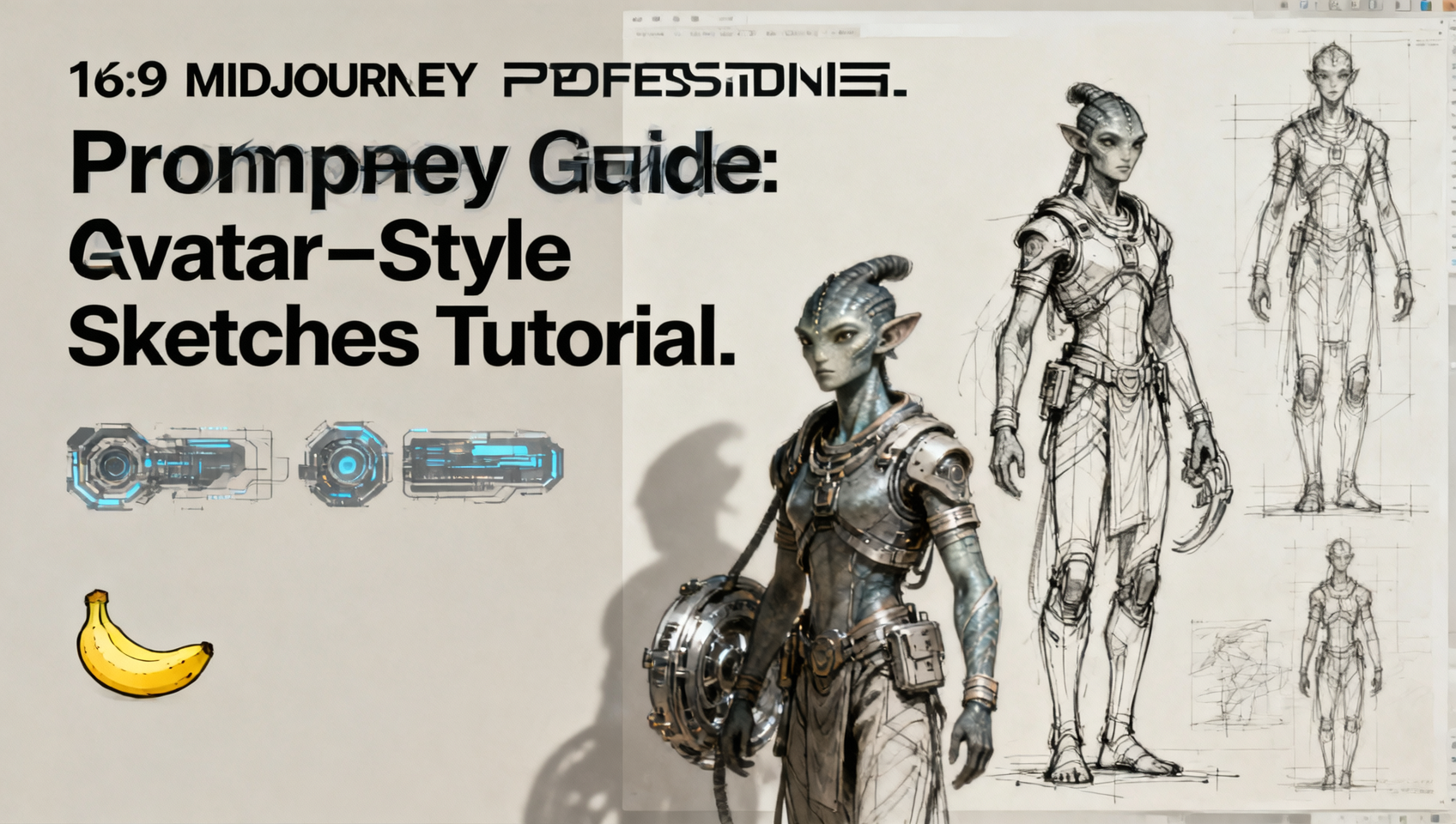
Creating Cinematic Concept Art with Midjourney
Concept art bridges the gap between abstract ideas and tangible production assets. When aiming for a specific aesthetic like the bioluminescent, organic technology seen in Avatar, generic prompts fail. You need precision in lighting, texture, and composition. Midjourney v7 offers the fidelity required for professional-grade concept sketches, but only if you understand how to steer the model using specific parameters and stylistic descriptors.
This guide breaks down eight distinct prompt structures designed to generate high-fidelity character and environment concepts. We move beyond basic descriptions into technical directives that control render engines, lighting models, and material definitions. Whether you are prototyping for a game or building a portfolio, these workflows provide a repeatable framework for consistent output.
Who This Guide Is For
This tutorial targets concept artists, indie game developers, and visual storytellers who need rapid iteration without sacrificing quality. It is also suitable for hobbyists looking to understand the mechanics behind professional AI art generation. If you are tired of random results and want to dictate the mood, material, and camera logic of your generations, this workflow is for you.
Core Prompt Structures for Avatar-Style Aesthetics
The following eight prompt categories cover the spectrum from organic character design to hard-surface industrial mechanics. Each example includes specific Midjourney parameters to ensure aspect ratio consistency and stylistic adherence.
01. Futuristic Lighting and Cybernetics
This style focuses on the intersection of biology and technology. The key here is specifying light sources as part of the anatomy rather than external lighting.
/imagine prompt: Na'vi cybernetic interface, bioluminescent neural nodes, futuristic lighting rig, dark background, volumetric fog --ar 16:9 --v 7 --style raw --s 250
Using --style raw reduces Midjourney's default aesthetic bias, allowing the "bioluminescent" descriptor to drive the color palette rather than the model's internal training on standard sci-fi tropes.
02. Cinematic CG: Deep Sea Shaman
For characters rooted in spiritual or natural elements, we shift towards subsurface scattering and organic textures.
/imagine prompt: Deep sea shaman character concept, translucent skin, organic armor made of coral, cinematic CG render, octane render, subsurface scattering --ar 3:4 --v 7 --q 2
The --q 2 parameter increases render time slightly but improves the quality of light interaction on translucent materials, crucial for underwater or spirit-like aesthetics.
03. Cinematic CG: Dynamic Archer
Action poses require clear silhouette definition. We prioritize dynamic tension in the musculature and equipment.
/imagine prompt: Tribal archer in motion, tension in bowstring, kinetic energy, detailed fabric physics, cinematic depth of field, bokeh --ar 16:9 --v 7 --chaos 10
Adding --chaos 10 introduces variability in the pose and camera angle, preventing every archer from looking identical across multiple generations.
04. Iridescent Ink and Spirituality
This approach blends traditional media textures with sci-fi subjects. It creates a hand-painted look suitable for lore books or stylized cutscenes.
/imagine prompt: Spirit walker concept, iridescent ink wash style, watercolor texture, glowing ethereal edges, white background, concept art --ar 3:4 --v 7 --style raw
The combination of "ink wash" and "glowing edges" forces the model to reconcile conflicting textures, often resulting in unique, artistic interpretations of character spirits.
05. Industrial Design and Hard Surface
When designing equipment or vehicles, clarity of function is paramount. We use keywords that imply engineering rather than art.
/imagine prompt: Alien industrial equipment, hard surface modeling, functional design, wear and tear, grease stains, orthographic view --ar 16:9 --v 7 --style raw
"Orthographic view" is a critical keyword here. It attempts to flatten the perspective, making the design easier to interpret for 3D modeling later.
06. Mechanical Sketches and Blueprints
For early-stage ideation, you want lines and structure, not full渲染 (renders).
/imagine prompt: Mech suit blueprint, technical sketch, white lines on blue background, annotations, schematic view, detailed joints --ar 16:9 --v 7
This prompt suppresses lighting and texture in favor of line work. It is ideal for establishing the mechanical logic of a character's exosuit.
07. Minimalist Light Sculpture
Sometimes the form is more important than the detail. This style strips away noise to focus on silhouette and lighting interaction.
/imagine prompt: Abstract character form, light sculpture, minimal geometry, rim lighting, dark void, high contrast --ar 1:1 --v 7 --style raw
Using a square aspect ratio (--ar 1:1) focuses the composition centrally, while "rim lighting" defines the edges without cluttering the interior details.
08. Cinematic Fantasy Environment
Characters do not exist in a vacuum. Environment prompts set the stage for your character concepts.
/imagine prompt: Pandora-like jungle environment, floating mountains, bioluminescent plants, atmospheric perspective, cinematic wide shot --ar 16:9 --v 7 --q 2
High quality (--q 2) is essential here to resolve the complex foliage and atmospheric depth without blurring distant elements.
Prompt Engineering Essentials
Integrating Workflows in MidassAI Studio
Generating the image is only the first step. Managing these assets requires a structured environment. MidassAI Studio provides a unified interface for running Midjourney workflows without needing Discord commands manually typed every time. You can save these prompt structures as templates, allowing your team to maintain consistency across different projects.
When working within the Studio, you can leverage the --sref (style reference) parameter more effectively. Once you generate a character style you like in category 02 or 03, copy the image URL and use it as a style reference for subsequent generations. This ensures that your Shaman and Archer look like they belong in the same universe.
/imagine prompt: [New Character] --sref [URL of approved style] --v 7This consistency is vital for production pipelines. In MidassAI Studio, you can organize these generations into projects, tag them by asset type, and export them directly for review. The platform also supports multimodal expansions, meaning once your concept art is approved, you can explore AI Video or AI Music tools to create pitch reels or animatics based on the static concepts you just generated.
Refining Your Output
Even with precise prompts, the first generation rarely hits perfection. Use the Vary (Region) tool in Midjourney to fix specific details, such as hand anatomy or weapon geometry, without regenerating the entire image. If the lighting feels too flat, add "volumetric lighting" or "god rays" to your prompt modifier.
Remember that Midjourney v7 responds well to natural language but respects parameters strictly. Do not bury critical parameters at the end of a long sentence. Keep --ar, --v, and --style distinct at the end of your prompt string.
Scaling Your Concept Production
The ability to rapidly prototype eight different visual styles allows you to present options to stakeholders quickly. Instead of spending days modeling a single character, you can generate twenty variations of the "Industrial Design" style in an hour, select the top three, and proceed to high-fidelity modeling only for those winners.
This efficiency does not replace the artist; it amplifies their decision-making speed. You remain the director of lighting, composition, and mood. The AI handles the rendering heavy lifting. By mastering these prompt structures, you shift from hoping for a good result to engineering a specific outcome.
Start Building Your Concept Library
Ready to implement these prompts in a production-ready environment? Stop copying and pasting into disjointed interfaces. Use a studio designed for iterative creative work.
Try Midjourney in MidassAI Studio to access these workflows, save your prompt templates, and manage your asset library in one place. Whether you are designing the next sci-fi epic or iterating on character skins, the right tools make the difference between a random generation and a production asset.